Artificial intelligence is moving from being a futuristic idea to becoming part of everyday work, business and decision-making. But as adoption grows, an important question is emerging: Are we simply using AI, or are we building the capacity to own and shape it?
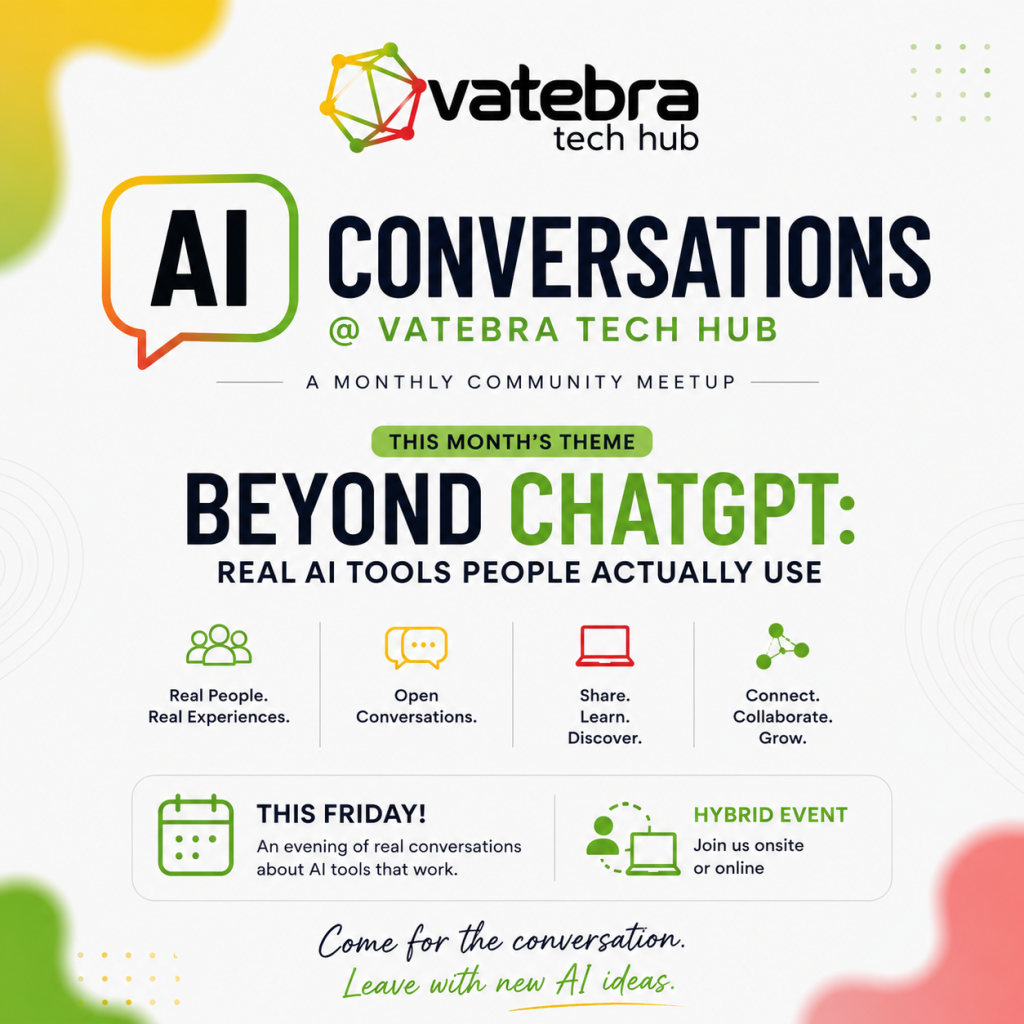
This was at the heart of AI Conversations at Vatebra Tech Hub, a cross-functional discussion held on July 31, 2026. The conversation brought together perspectives on AI adoption, productivity, infrastructure, local-language preservation, privacy, automation, job displacement and the risks that come with increasingly autonomous systems.
From AI Anxiety to AI Productivity
The conversation began with a fundamental question: How can AI increase productivity, and what happens when its adoption is not properly understood or managed?
Participants discussed how perceptions of AI can change with exposure and understanding. Some people initially approach AI with fear or skepticism, while greater familiarity can reveal practical ways it can support everyday work.
Policy and regulation emerged early as important drivers of responsible adoption. Participants noted that national awareness and clear expectations around where AI fits within the economy will be important as adoption continues to grow.
The takeaway was not that AI should simply be embraced without question. Rather, the conversation highlighted the need to understand where AI creates value, where it introduces risk, and how people and organisations can prepare for both.
The Infrastructure Problem Behind AI
One of the strongest themes from the discussion was that AI adoption is not only about software.
It is also about infrastructure.
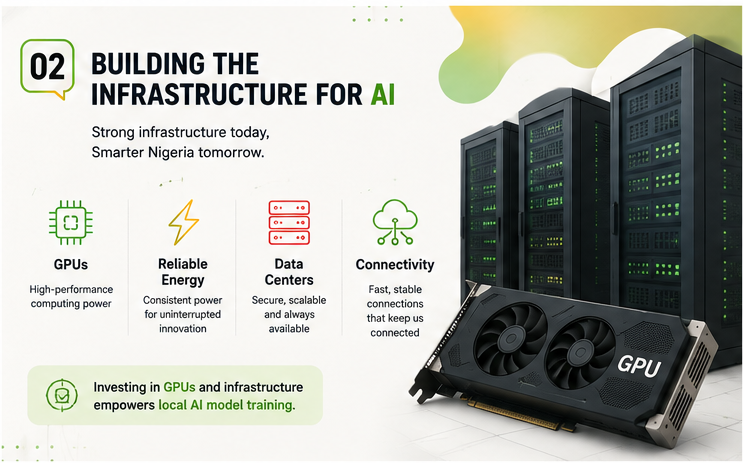
Participants identified unreliable energy, limited data-centre capacity and access to GPUs as significant challenges to local AI development. These limitations contribute to dependence on models trained elsewhere, raising questions about whether those models can adequately understand and serve Nigerian realities.
Advanced AI systems require enormous computing resources, while local organisations and developers face practical infrastructure constraints.
This creates an important strategic question for Nigeria:
What happens when a country becomes a heavy user of AI without developing the infrastructure and capacity to build and control its own systems?
The discussion pointed towards investment in GPUs and related infrastructure as one possible path toward supporting local model training.
Building AI That Understands Nigeria
AI does not exist in a cultural vacuum.
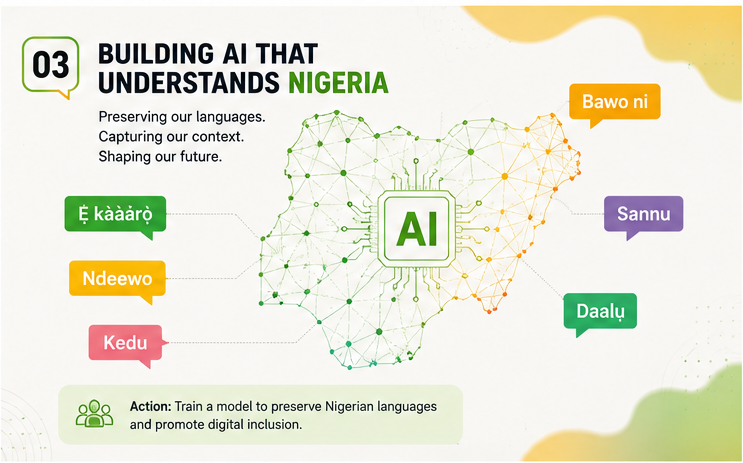
Language, accents, context and local knowledge all influence how technology interacts with people. During the conversation, participants raised concerns about the possibility of cultural and linguistic erasure if local languages are not represented in AI systems.
The group discussed the need to collect local language data and train models that can better capture Nigerian syntax, accents and linguistic patterns. One of the proposed action points was to explore training a model specifically to help preserve Nigerian languages.
This goes beyond simply making technology easier to use.
It is about ensuring that as AI becomes part of the digital world, Nigerian languages and cultural knowledge remain part of that world too.
The conversation also raised concerns around the ways data—including books and other forms of content—can be acquired and used for model training, highlighting the need for greater awareness of data practices.
AI Is Already Changing How Work Gets Done
While much of the conversation focused on the big-picture questions surrounding AI, participants also shared practical examples of how AI is already changing workflows.
One example involved business development. AI models can be used to generate and qualify leads and support outreach activities, allowing organisations to automate tasks that traditionally required significant human effort.
The discussion made an important point: AI adoption is not necessarily about replacing an entire job at once.
Often, it starts by replacing individual tasks.
As more tasks become automated, organisations may begin to rethink how roles are structured, how teams operate and which activities genuinely require human intervention.
The Privacy Question: What Happens to the Data We Give AI?
The convenience of AI comes with another important consideration: data privacy.
Participants discussed the risks associated with uploading private financial documents, business information and other sensitive materials into third-party AI platforms.
Users may share information with an AI tool simply because it is convenient, without fully understanding what happens to that information or the implications of relying on an external system.
For organisations, this raises the need for stronger AI governance.
Businesses increasingly need to ask:
- What information can employees provide to AI tools?
- Which platforms are approved for business use?
- What data should never be uploaded?
- When should an organisation consider an in-house or private AI solution?
For some organisations, the answer may involve deploying open-source models locally or on private infrastructure rather than relying entirely on external providers.

The Problem With AI Isn’t Always the AI
Another interesting point from the discussion was the role of AI literacy.
AI tools can appear ineffective when users do not understand how to select the right model, structure instructions or provide sufficient context. Participants emphasised that getting useful results often depends on knowing which model is appropriate for a particular task and developing stronger prompting skills.
In other words, simply having access to an AI tool does not automatically make an organisation AI-enabled.
There is a learning curve.
The organisations that benefit most may be those that invest not only in technology, but also in people who understand how to use, evaluate and manage that technology.
What Happens When AI Takes Over Hiring?
Perhaps one of the most striking parts of the conversation was the discussion around recruitment automation.
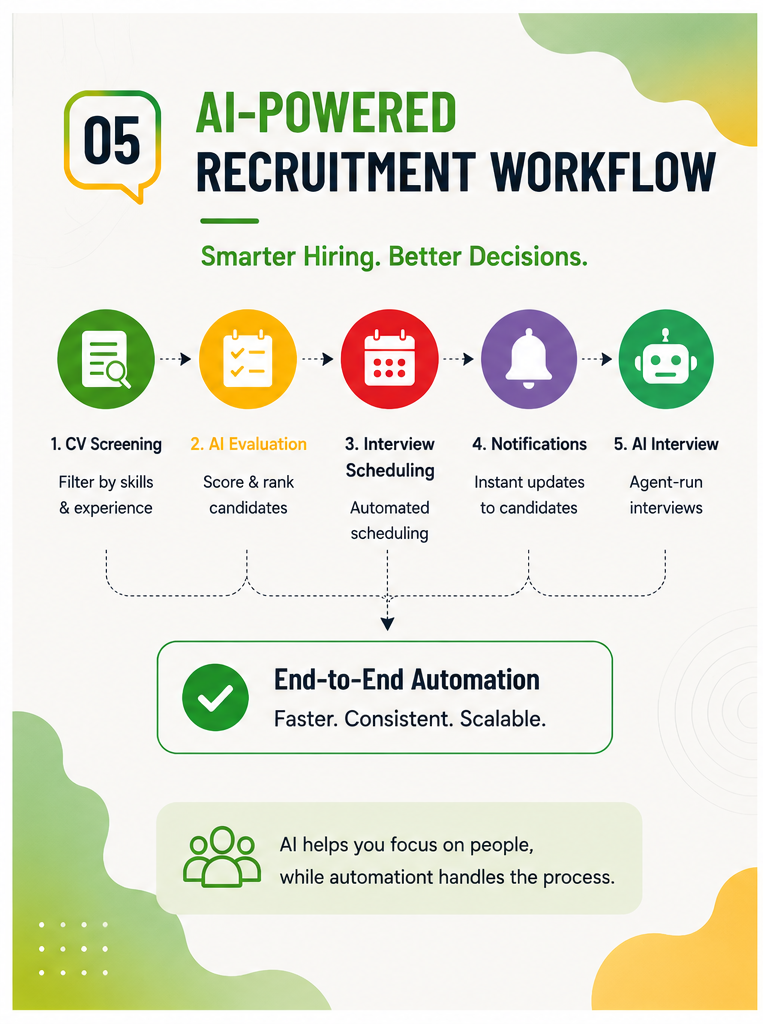
Participants shared an example involving n8n, where an automated workflow could create templates, filter CVs based on skills and years of experience, schedule interviews, send notifications and support an end-to-end interview process involving AI agents.
This represents a significant shift from traditional recruitment.
An AI-powered hiring process can apply predetermined questions and evaluation criteria consistently, potentially allowing organisations to process large numbers of applicants more efficiently.
But efficiency introduces new questions.
What happens to fairness?
What happens to candidate experience?
And perhaps most importantly:
Who is responsible when an automated system makes the wrong decision?
The discussion recognised that while standardisation can improve consistency, it can also remove some of the interpersonal elements of recruitment and create new concerns around fairness.
Will AI Take Jobs?
The conversation inevitably moved towards one of the biggest questions surrounding artificial intelligence: job displacement.
Participants identified areas such as portions of HR, business development and even radiography as examples of work that could be affected by AI-driven automation.
But the discussion did not end with the conclusion that humans would simply become unnecessary.
Instead, another possibility emerged.
As organisations automate more frontline and routine activities, they will also need people who can implement, monitor, maintain and manage AI systems.
Automation may therefore eliminate some roles while creating new ones around the technology itself.
The future of work may not be about choosing between humans and AI.
It may be about determining which work should be done by humans, which should be automated, and how the two can work together effectively.
When Automation Creates New Security Risks
More automation also means more responsibility.
Participants discussed security concerns associated with systems operating with reduced human oversight, including examples of AI systems identifying previously unknown vulnerabilities and platforms where AI systems can interact autonomously.
This creates a difficult balance.
Organisations want the cost savings and efficiency that automation provides. At the same time, the more authority an automated system receives, the greater the potential consequences when something goes wrong.
The question becomes:
How much autonomy is too much?
And where should humans remain firmly in the loop?
Can Organisations Still Operate Without AI?
One of the most provocative questions raised during the session was whether organisations can realistically choose to operate without AI agents.
With organisations receiving large volumes of applications and dealing with increasingly time-consuming administrative processes, some participants argued that it may already be difficult to return entirely to manual workflows.
That does not mean every process should be automated.
Rather, it suggests that AI is becoming part of the organisational infrastructure that businesses must learn to understand—even if they ultimately decide that certain processes should remain human-led.
The Bigger Question: Who Owns the AI Future?
Perhaps the biggest message from the conversation was that AI adoption alone is not enough.
Nigeria needs to think about ownership.
Who owns the models?
Who owns the infrastructure?
Who controls the data?
Who determines what local languages and cultural contexts are represented?
And who is responsible when AI systems make decisions that affect people’s lives?
The discussion highlighted the strategic value of owning AI models and infrastructure while also recognising that open-source models can provide more accessible alternatives that organisations can customise and deploy locally or on private servers.
From Conversation to Action
The AI Conversations session did not end with discussion alone. Several action points emerged from the meeting:
1. Increase AI awareness and understanding
Government and relevant regulatory bodies were identified as having a role to play in increasing awareness around AI adoption and its risks.
2. Explore investment in GPUs and infrastructure
Participants identified investment in computing resources and related infrastructure as important for supporting local model development.
3. Support Nigerian language preservation
The group proposed training a model capable of helping preserve Nigerian languages and capturing local linguistic characteristics.
These are ambitious goals, but they reflect a broader shift in the conversation—from asking “What can AI do for us?” to asking “What kind of AI future do we want to build?”
AI Conversations: Beyond the Hype
The most valuable outcome of the conversation was perhaps its refusal to treat AI as either a miracle solution or an existential threat.
AI can improve productivity.
It can automate repetitive work.
It can support businesses and create new opportunities.
But it can also introduce privacy risks, bias, misinformation, security vulnerabilities and disruption to traditional jobs.
For Nigeria, there is an additional layer: local ownership and relevance.
The country cannot afford to be only a consumer of technologies built elsewhere. Building the infrastructure, skills, datasets and models needed to participate meaningfully in the AI economy will be just as important as learning how to use the latest AI tools.
That is why conversations like this matter.
Because the future of AI will not be determined only by the technology itself. It will also be determined by the people, organisations and communities willing to ask the difficult questions about how that technology should be built and used.
And at Vatebra Tech Hub, the conversation is only beginning.